Monday, December 12, 2011

Work space

The basic project can be done on a stove top but for control purposes
I want
a glove box/flow hood, Commercial glove boxes seem to start at about 1000$
a scientific hotplate for exact temp control
an induction hotplate for rapid melting
an IR thermometer
a flow regulator and lines for the shield gas
a bottle of argon
a couple graphite crucibles
refractory board to protect the plastic in case of spills
Kaowool to insulate the crucible to slowing cooling for crystal growth testing
gloves that attach permanently to the box and create part of the seal
some oven mitts (the industrial kind)

I could probably get away with, several less exact options for this testing but I would hate to figure out I needed a proper glove box 3 weeks into the project.

My design so far is a box with a slanted front for viewing. Currently I'm aiming for 24L X 20W X 18-30H
18 inches at the front 30 in the back.
I'm planning on the following
Black ABS for the sides, base and back. I would prefer white for thermal reflectivity, but the thicknesses I want seem scarcer and therefore more expensive. ABS has good thermal properties which are a concern for this project.
The front, and top will be clear Polycarbonate. This plastic is fairly stable thermally and will put up with the mechanical wear, and stresses of the glove holes very well.
At tap plastics the pre cut pieces would run me just around 220$ for materials and another 40$ or so in labor to laser cut the parts to proper shape.
The box also needs gloves. These are usually attached inside and outside of the box with a pair of circular gaskets.

It would look something like this...
I will need power and a gas connector, valve on the exit. 
Last bit is the tricky bit of opening and closing the box while still being able to seal the box. 

Sunday, December 11, 2011

Oxidation control and purity concerns

In my research I saw the importance of oxidation control, this will keep the expensive purity you paid for. This can still be done in open air, it just cuts down the number of times you can remelt bismuth and still get really nice oxidation colors on the crystals. What you melt the bismuth in is also important. Liquid bismuth will alloy with most metals in very small percentages, but even small adds up when your starting at 99.99%. Stainless steel works, but if you plan on remelting several times and still want good results you want a graphite crucible like the kind used in gold and silver casting.

Controlling the air in your crucible isn't actually too hard. A lid during heating will certainly slow down the skin formation. I plan on building a simple flow hood, not for the skin formation, but so I can attempt to determine the critical oxidation temps/rates. Since bismuth naturally oxidizes in air, there isn't going to be a hard temperature at which the colors form. It will probably be a time/temp/mass graph.

For this project I want precise temperature control which will require a scientific hot plate. Luckily a hot plate still works in a non oxygen atmosphere.  A basic flow hood really isn't more than a box with a door and a bottle of shield gas, But I figure I will spend the 50% extra time to do it much closer to right. there will be pictures later, hopefully I get funded.

On a side note it appears you can reclaim that bismuth oxide scum by heating   it to a high temp with carbon under a shield gas. This probably wont be useful unless you are manufacturing things with bismuth, and going through many melt cycles.

Saturday, December 10, 2011

Some light reading

Between youtube, personal websites and the mailing lists there is a bit of information regarding the basic process of growing the crystals from bismuth.

The physical process driving the formation of hopper crystals is that while cooling the edges attract more molecules than the center.
This site has a nice general over view of bismuth and some good photos of close ups of crystals.

The basic process is as simple as melt, pause, pour.
A couple of youtube videos that demonstrate the process.

This one seemed like the most realistic Edisonian demonstration. At the end before the commercials, there is a close up of a couple of small crystals with good color.

This video clearly demonstrates the need for high purity bismuth. The hopper crystals still formed, but the entire block still has a bronze color without any of the iridescence.

In this video you can see the beautiful colors from the oxidation. There is a built in lesson in there, the interiors of the the crystals are not cleaned. Care needs to be taken to "shake" the liquid out before it cools covering the details.

Those cover the basics, the details for growing larger crystals took some actual reading.

I read a lot of things and this was the most comprehensive first hand knowledge of achieving decent results.
But after reading it I think for the best results, using a flow hood with a shield gas, and something simple like an aquarium pump to color the crystals before they cool past the critical temperature.

Some testing will need to be done.

Some data on cooling rates/size

Thursday, December 8, 2011

The beginning

I will be using this space to chronicle my exploration in growing bismuth hopper crystals.

The author of this blog assumes no responsibility or liability for the information or processes involved. Playing with hot liquids is inherently dangerous and before attempting any of the things described on this site, be informed, and prepared!

I've had occasion to be fascinated by bismuth several times in my life so far. The first time was my discovery of its use in low melting point alloys as a lead free pewter alternative. Later I ran across its magnetic properties, as far as I know its the only naturally occurring material you can float a magnet on.

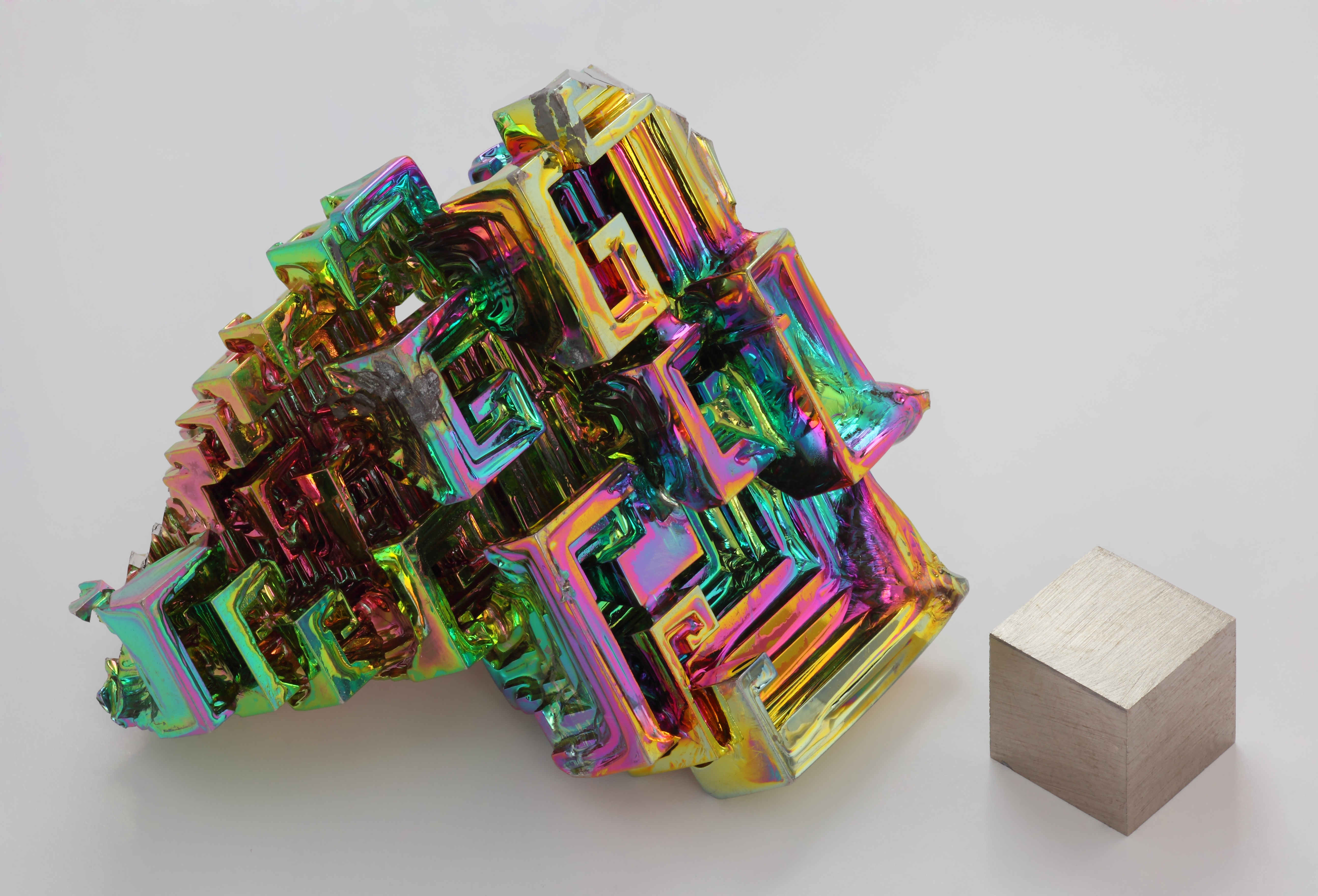
But  here we will be exploring Hopper crystals.

This photo is courtesy of Wikimedia and has been retouched a little, for focus.

The basic process is to melt some bismuth and either dip in a seed crystal or pour out the excess after after it has partially set. These crystals form during the cooling process, and get exposed by interrupting the freezing. Its a little like making a freezer pop, just at much higher temperatures.
A simple search on youtube for "bismuth crystal" brings up have a dozen videos that involve nothing that's truly higher tech than fire and metal. Melt, wait, pour... *oh pretty*.
The iridescent colors are caused by oxidation layers. Bismuth actually oxidizes to a pink color, its the pink in Pepto, the iridescent colors are caused by depth changes in the oxidation layer. Like the rainbows that oil makes on water.